In mid-seventeenth-century Delft, Pieter de Hooch and Johannes Vermeer were the pre-eminent artists. Though Vermeer was without question superior and ability was distant, their relationship was almost certainly very close. Very little is known of either painter; Vermeer is even referred to as the sphinx of Delft, but one can trace their pseudo-partnership through their oeuvre and the influence exerted by each on the other.
De Hooch was three years older than Vermeer, and despite the latter's earlier entry into the Delft Guild of Saint Luke, De Hooch reached artistic maturity much earlier; one can pin it at his peak in 1658. Earlier maturity in style was likely spurred by economic needs with his new family; his daughter Anna was born in late 1656. Vermeer, on the other hand, moved between genres, including religious works such as Diana and Her Companions, until first exploring his few-figure genre scenes around 1658, reaching maturity a few years later. Moreover, Vermeer's only dated picture from the 1650s, the Procuress of 1656, is a large animated genre scene in the tradition of the Utrecht Caravaggisti. With its dark and shallow composition, the picture bears little resemblance to the art he subsequently produced.
One would assume, from the superior positioning of Vermeer in the canon, that De Hooch would be the subordinate in their artistic relationship, taking cues from the greater artist, but the timing of their respective maturity paints a more complicated scenario. De Hooch's interiors of circa 1658 developed a rectilinear spatial organisation, lucid daylight, and carefully structured domestic setting which would shortly become central to Vermeer's work. See for instance A Maid Asleep of 1656–1657, Vermeer's second genre scene, which adopts the vista, doorkijkje, motif used earlier by De Hooch. The designs of Vermeer's The Glass of Wine in Berlin and The Girl with the Wine Glass in Braunschweig were more than likely inspired by De Hooch paintings such as Card Players in a Sunlit Room and A Woman Drinking with Two Men. Blankert dates the two Vermeers to 1660–61 and 1662 respectively.1
Still, the wider Delft artistic environment must too be considered. Motifs, figure types, perspectival devices, and compositional formulae circulated between painters such as Anthonie Palamedesz., Hendrick van der Burch, De Hooch, and Vermeer. Their relationship is therefore better understood as an unusually productive strand of a broader local network of influence.
 Pieter de Hooch, Card Players in a Sunlit Room
Influence and shared sources
Composition and motif
On inspection of individual compositions, a relationship becomes even clearer. In De Hooch's Two Soldiers Playing Cards and a Girl Filling a Pipe and Vermeer's Soldier with a Laughing Girl, three-quarter-length figures sit around a table beside a window, with the darkened form of a soldier occupying the near side of the composition. Valentiner correctly recognised the similarity but incorrectly placed Vermeer as having supplied the prototype.2


If you look at other earlier compositions by De Hooch you see the repetition of elements not previously seen in any Vermeer. From the De Hooch, compare the tablecloth to that in The Visit or A Girl Drinking with Two Soldiers, compare the identical male figure on the right to that in A Woman Drinking with Two Men, and compare the female figures in them all. You can also compare the painting, perhaps a moralising force for the image by depicting Jesus and the woman taken in adultery in the background, from De Hooch's canvas to that in Drinking with Two Soldiers.


Yet there is still more genealogy to consider, originating from De Hooch's brother-in-law Hendrick van der Burch, with whom plenty of motifs are shared. Vermeer's Soldier with a Laughing Girl (1657) appears to combine the spatial and compositional scheme of De Hooch's canvas as mentioned, but it seems he also adopted the figure from van der Burch's Guardroom Interior (c. 1650–1655). In fact, De Hooch himself had already borrowed the silhouette of this figure, albeit reversed, in Players at Tric-trac of about 1652–1655.


Thus the implication goes that Vermeer took inspiration from De Hooch. Compared to Two Soldiers Playing Cards and a Girl Filling a Pipe, Vermeer undoubtedly improves upon De Hooch's model. He reduces the number of figures and furnishings, balances the composition, and replaces De Hooch's somewhat angular actors with figures that are more pliant and emotive. Yet the essential components of the design had already been outlined by De Hooch.
Earlier sources
De Hooch certainly took plenty of inspiration himself. His main source stems was a slightly earlier guardroom and merry company tradition, from painters such as Anthonie Palamedesz. and Dirck Hals. See, for instance the main figure in Two Soldiers and a Serving Woman with a Trumpeter and a sketch from a decade earlier by Palamedesz., and there is no doubt of a direct inspiration from the older Delft painter to the younger. Palamedesz.'s influence was not restricted to its bearing on De Hooch, for he was probably the single most influential artist in Delft; his types, poses, and guardroom vocabulary formed part of the wider visual language inherited by the younger generation of Delft painters.
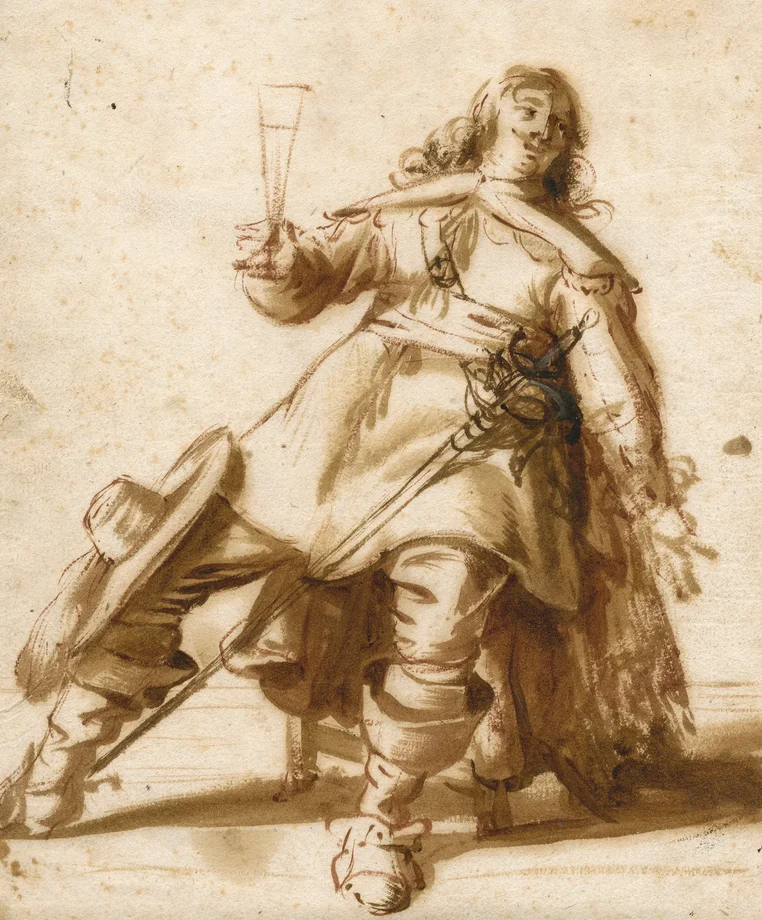

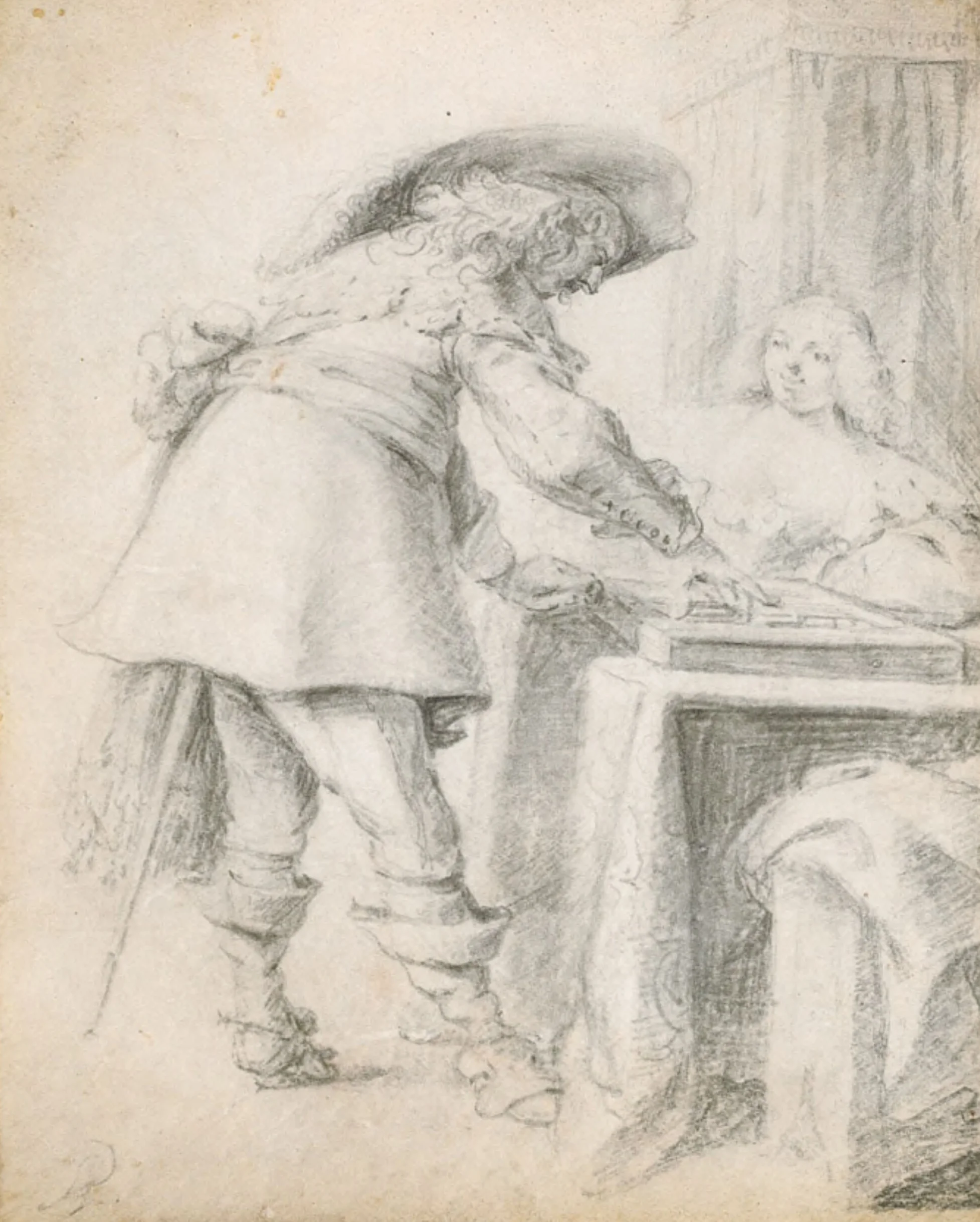
There is also a direct lineage for the composition shared by De Hooch and Vermeer, originating from Dirck Hals. The most conspicuous common element is the seated male figure at lower left, wearing a broad-brimmed felt hat. De Hooch retains the cuirass of his earlier guardroom figures, whereas Vermeer dresses his officer in a red coat and black bandolier; both figures, however, appear to descend from the Dirck Hals drawing below.
 Dirck Hals, Sitting Man with a Sword, circa 1630
Yet De Hooch's mature art depended upon another tradition quite different from the guardroom painters. Perhaps his greatest achievement was his ability to translate the advances of Dutch church-interior painting in perspective, light, and architectural recession into domestic genre painting. For instance, take his direct adoption of the trompe-l'œil curtains from a work by Hendrick van Vliet, the last remaining church painter in Delft after an exodus to Amsterdam:
 Pieter de Hooch, A Soldier Paying a Hostess, 1658
Style and technique
Composition, light, and surface
Throughout Vermeer's small corpus of about 34 works, compositions of only one or two figures make up the vast bulk of his canvases. Compared to De Hooch, who often depicted a large group of active figures and architectural features to boot, Vermeer's work is much more restrained in scope. The excess of De Hooch may also be seen in his light sources. Compared to the usual fixed source of light emanating from an upper-left window in Vermeer's works, De Hooch employs multiple light sources, letting light enter from several directions and move across a chain of rooms.
Compared to De Hooch, Vermeer confines the action to a very small portion of the room, effectively a single corner, and places only one or two figures within it. The reduction concentrates attention on quietude, gesture, and the emotional relationship between those few figures rather than on the architecture or activity of the household as a whole. One of the more persistent criticisms of De Hooch is that his figures can seem too long, slender, angular, and rigid, with comparatively little attention paid to the elaboration of their faces or to subtle interpersonal expression. Vermeer's restricted casts allowed him to make these relationships the centre of the composition; De Hooch's figures more often serve the larger organisation of the room.
De Hooch's light tends to be clearer and more silvery, producing stronger contrasts and darker shadows; Vermeer rather compresses the effect into a more controlled and unified image. De Hooch's brushwork is consistently more descriptive and naturalistic, particularly in distinguishing brick, plaster, cloth, wood, and glass, whereas Vermeer is more abstract, with roof tiles and bread crusts seemingly built from the same substance.
Both were particularly alive to secondary reflections. A glow beneath the window in Two Soldiers Playing Cards and a Girl Filling a Pipe reappears in Vermeer's Soldier with a Laughing Girl and De Hooch's A Girl Drinking with Two Soldiers. The girl pouring wine in A Merry Company with Two Men and Two Women is herself reflected in the window, resembling the mirrored detail in Vermeer's Girl Reading a Letter at an Open Window.

There is also a significant thematic distinction between the two painters, in that children are entirely absent from Vermeer's compositions, whereas they recur throughout De Hooch's domestic scenes, mostly relating to the intimate relationship between mother and child, and often specifically mother and daughter.
Colour
Colour was another shared concern. Around 1658 De Hooch's palette becomes increasingly dominated by purer unmixed hues. Hans Jantzen later made this development central to his study of colour in seventeenth-century Dutch painting. In A Woman Nursing an Infant with a Child and a Dog, the costume of the nursing mother is almost reduced to the primary triad of red, yellow, and blue. The simplicity of the palette mirrors the simplicity of the design.
Vermeer's The Milkmaid operates in much the same territory. It too relies heavily on primary colour, and perhaps responds to De Hooch's experiments. Both paintings have something almost classical about them: the design, colour, and light have been stripped of anything unnecessary.


It would be wrong to turn all this into a claim that Vermeer simply copied De Hooch. De Hooch was clearly affected by Vermeer in turn, and Vermeer almost invariably takes the shared idea further. But by 1658 De Hooch had arrived at a mature visual language before Vermeer had done so. For at least this brief period, the greater painter appears to have been following the lesser.
Technique and perspective
We do not know from whom De Hooch or Vermeer learned the art of perspective. Both generally constructed their domestic spaces according to one-point, or central, perspective, a system widely practised by seventeenth-century painters and codified in earlier treatises such as Pelerin's, and Cousin's treatise on perspective. De Hooch's father was a master bricklayer and would certainly have had a mason's command of practical geometry; it is therefore possible that De Hooch first encountered some of the principles underlying perspective through his father's profession, and difficult not to wonder whether some of Pieter de Hooch's exact attention to masonry originated here.
For reference, in central perspective a horizon line is first established and a single central vanishing point marked upon it. The principal receding lines, or orthogonals, then converge upon that point, allowing floors, walls, and architectural elements to be constructed as parts of one coherent spatial system, for example in this Vermeer:
 Perspective reconstruction of Vermeer's A Lady Standing at a Virginal, showing the orthogonals, the vanishing point (vp), the horizon line (hl), and distance points (dp and dp')
De Hooch seems to have constructed the linear foundations of his interiors with a remarkably practical method. A pin was placed at the vanishing point with a string attached to it, allowing the orthogonals to be sighted directly. The same technique appears in Vermeer. A pinhole was first observed in his Artist's Studio in Vienna by K. G. Hulten, and Jørgen Wadum later discovered similar pinholes in more than a dozen Vermeers (at least 17 by a count from RKD Studies). At least a dozen De Hoochs also contain them.3
 Left detail of Woman Holding a Balance showing the small pinhole, and right, the same detail in the X-ray where the hole was subsequently filled with radio-absorbent paint
The method of using the pinhole was relatively primitive, applying chalk to a taut string and snapped against the prepared ground. Two 'distance points' could then be placed equidistant from the central vanishing point on the horizon, generally outside the picture plane, to establish such elements as the diagonals of a tiled floor. The distance between these points and the central vanishing point determines the position of the viewpoint and, in conjunction with the width of the picture plane, the viewing angle.
De Hooch, contrary to such evidence, was not quite enslaved to geometry. He sometimes introduces a second vanishing point or even a second horizon into a picture. By strict Keplerian optics these spaces can be wrong, but they usually feel right. For instance in Pieter de Hooch's A Woman Drinking with Two Men, though we don't notice the distortion, a strict analysis of the geometry of the room suggests the size of the woman in the foreground is wrong. Relative to the other figures she must be about seven feet tall.
Pieter de Hooch, A Woman Drinking with Two Men
Whether these departures from strict central perspective were deliberate is more difficult to establish, but it is more likely that De Hooch purposely accommodated the moving eye rather than forcing the viewer into one mathematically perfect position, deliberately tweaking the system to create a more persuasive spatial illusion; alternatively, some inconsistencies may simply reflect difficulty in applying its rules. If the distortions were deliberate, he is close to Emanuel de Witte, whose church interiors similarly use perspectival 'errors' to create a more convincing experience of space. Vermeer is much stricter with positioning, perhaps owing to the camera obscura. Perspective, in any case, was never purely a matter of converging lines. Seventeenth-century painters, owing to earlier developments in the field of perspective, knew that colour and value were just as important to the construction of depth; Desargues even advertises his perspective treatise as explaining both geometry and 'the position and proportion of strong and weak effects of light, or colours.' The Dutch term houding described this problem of the binding together of size, colour, light, shadow, and distance so that each object occupies a convincing place in the whole.
One contemporary definition calls it 'that which binds everything together in a drawing or painting, which makes things move to the front or back, and which causes everything from the foreground to the middleground and thence to the background to stand in its proper place without appearing further away or closer, without seeming lighter or darker than its distance warrants; so that everything stands out without confusion from the things that adjoin and surround it, and has an unambiguous position through the proper use of size and colour, and light and shadow; and so that the eye can naturally perceive the intervening space, that distance between the bodies which is left open and empty, both near and far, as though one might go there on foot, and everything stands in its proper place therein.'
That last phrase might almost have been written specifically for De Hooch; his best Delft interiors are convincing because they appear traversable. The viewer understands not only where the wall is, but the empty space within, augmented by his use of doorsiens (narrative views created by physically opening a door pointing outside of the immediate scene).
De Hooch generally worked over light-to-medium grey or beige upper grounds during the Delft period. The grey preparation contributes directly to the distinctive cool luminosity of the Delft paintings, since De Hooch frequently allowed the ground to remain optically active within the finished image rather than completely covering it with opaque paint. Comparable grounds occur in works by Vermeer and other Delft painters, which seems to imply either a shared local workshop practice or the use of the same suppliers of pre-primed supports.
De Hooch generally relied on less costly pigments than Vermeer, who famously used expensive ultramarine; De Hooch more often employed smalt, a pulverised cobalt glass. Smalt has often turned transparent or discoloured with age, one example being the dress in A Woman Drinking with Two Men. He also used the fugitive yellow lake 'schietgeel' to make greens. As the yellow faded, foliage which had originally been green could be left blue. De Hooch did occasionally venture into more expensive materials, with vermilion appearing in some courtyard scenes.
 Detail of blue sky in View of Delft, showing the lead-white underpaint through the thin layer of ultramarine blue
Reciprocal influence
Amsterdam connections
De Hooch's move to Amsterdam did not end the relationship. Indeed, one of the strongest pieces of evidence for their back-and-forth comes from after he had left Delft.
A Woman Weighing Gold Coins against Silver Coins is unusual in De Hooch's oeuvre. Three-quarter-length paintings of a single woman in the corner of a room were Vermeer's territory far more than his, and the painting was consequently sold several times as a Vermeer. Its resemblance to Woman Holding a Balance in Washington is glaring.


In each, a woman stands in profile by a window, holding a balance above a table. This motif was not new—Dou, Bramer, Willem de Poorter, and perhaps Metsu had all painted figures with scales—but the two pictures are too close for that general tradition to explain such an uncanny resemblance.
Being that such compositions were more characteristic of Vermeer, it would be natural to conclude that De Hooch borrowed from Vermeer. However, modern imaging techniques like radiographs confuse such an assumption. They show that De Hooch initially painted a seated figure on the far side of the table and then removed it. It is difficult to see why he would first complicate Vermeer's already simplified composition only to return towards it afterwards. More plausibly, De Hooch arrived at the idea independently or first, and simplified it during execution.
For all this, Vermeer still does the better job at executing this scene. De Hooch leaves an open window to the left and a doorway to the right, allowing the eye to escape into several spaces. Vermeer, as is his speciality, closes the composition down. The scales move almost precisely to the centre, the diagonal fall of light divides illumination from shadow, and the Last Judgement behind the woman fills roughly one quarter of the rectangular surface.
The painting featured in the background of Vermeer's canvas, the Last Judgement, also adds an interpretative dimension absent from De Hooch's picture: a clavis interpretandi (key to interpretation). The woman weighing material objects before a painted image of the final weighing of souls has its obvious implications. At the same time it acts formally, framing the white headdress and balancing the mass of the figure.
This convoluted relationship between De Hooch and Vermeer is better described by the old concept of aemulatio than simple imitation. An artist could conspicuously adopt another painter's subject or design precisely in order to improve upon it. Samuel van Hoogstraten compared such borrowing to a bee moving from flower to flower and taking only the honey: 'a painter's spirit may take what is useful from the examples of others.'
Genre and meaning
The removal of Vermeer's Last Judgement from De Hooch's version also points towards a wider difference in how the two artists handle meaning. The moralising intentions of Dutch genre scenes have at times been pushed too far by modern scholarship. De Hooch depicts objects and pictures which could carry associations for a seventeenth-century viewer, but they usually remain subordinate to the actual event being painted wherein regular activity occurs.
Vermeer's Woman Holding a Balance sits on the opposite side of the spectrum, the Last Judgement sitting directly behind its principal action practically begging for interpretation. De Hooch's A Woman Weighing Gold Coins against Silver Coins does not.
Gerbrand van den Eeckhout's Party on a Terrace of 1652 provides a useful example of the more explicit iconographic tradition against which such works could operate.4 De Hooch's restraint may therefore not be a lack of meaning so much as an unwillingness to make that meaning the focus of the picture. An interesting case of explicit iconography in De Hooch's work can be found in A Woman with a Basket of Beans in a Garden.
Later dependence on Vermeer
Though the balance seems to be in De Hooch's favour thus far, after the mid-1660s the direction of influence becomes much less flattering to him.
Take A Couple with a Parrot, the action takes place beyond a darkened doorway in a bright room. De Hooch effectively turns his usual doorkijkje inside out: what would normally be a secondary glimpse is the main subject of the painting. The broader idea has precedents in Dou, Fabritius, Van Hoogstraten, and Steen, but its immediate source is obviously Vermeer's The Love Letter.


Where the earlier paintings can be called dialogue or aemulatio, this is certainly closer to a straightforward dependency. Other late paintings too retain traces of Vermeer. Valentiner compared the woman seated in the light in A Couple Playing Cards, with a Serving Woman with The Glass of Wine. The hostess in Paying the Hostess may similarly preserve some memory of Woman Holding a Balance.
 Pieter de Hooch, Paying the Hostess, Metropolitan Museum of Art (c. 1670)
Reputation and reception
Collecting
During his lifetime De Hooch's paintings seem to have brought respectable but wholly unspectacular prices. Presumably in exchange for room and board, 11 of De Hooch's paintings had entered Justus de la Grange's possession by 1655, all valued between 6 and 20 fl. A Van Beyeren in the same inventory stood at 100 fl.; a Lievens and a possible Carel Fabritius at 40 fl.; and a 'trony van Rembrant' at 20 fl. De Hooch therefore sat broadly among the ordinary genre painters rather than at either extreme of the market.
His prices increased slowly in the seventeenth century. By the mid-eighteenth century he had gained some reputation, and in a sale of 1763, Woman and Child in a Pantry and Card Players in a Sunlit Room fetched 450 and 480 fl.
 Pieter de Hooch, Woman and Child in a Pantry
Yet De Hooch still remained far below the Leiden fijnschilders and their notoriously high prices. In a sale of 1771, A Girl Drinking with Two Soldiers brought 420 fl. and A Soldier Paying the Hostess 500 fl., while Dou's triptych sold for 14,000 fl.
The specific language in these sale catalogues makes the difference in taste especially clear. A Merry Company with Two Men and Two Women was praised in 1784 as being 'in the manner of E. van der Neer'. A Sick Woman was compared favourably with Netscher, Mother and Child by a Cradle with Dou, and A Musical Party with Terborch. The French dealer Paillet said in 1784: 'nous ne plaçons pas les tableaux de ce maître au premier rang: à cause de Metzu et Terburg — qui ont traité ce genre avec plus de supériorité' ('We do not rank the paintings of this master among the very finest, because of Metsu and Ter Borch, who treated this genre with greater mastery'). During the same trip, he acquired Woman Giving Money to a Servant-Girl.5
De Hooch was nevertheless collected extensively by the most important Dutch collectors of the period. Due to the Dutch home advantage, France was a bit slower to catch up. The French seem to have known the later works better than those from Delft, presumably because comparatively few early De Hoochs had left Holland. When Woman with a Baby on her Lap appeared in a sale in Paris in 1784, J. B. P. Lebrun called De Hooch 'Ce maître, peu connu en France' ('a master little known in France'), but praised his command of 'la magie des effets du soleil & des reflets' ('the magic of sunlight effects and reflections'). Eight years later he remarked that De Hooch's true merit had long been overlooked because sellers substituted the names of more fashionable painters in order to obtain higher prices.6 His only notable criticism was that the works sometimes displayed 'trop d'un demi-teinte' ('too much half-tone'), probably evidence that De Hooch's later paintings had already darkened.
Rediscovery in the 19th century
By the nineteenth century, taste had swung heavily in De Hooch's favour. Théophile Thoré's pioneering work on Vermeer consistently forced the two Delft painters together. He attributed several De Hoochs to Vermeer and concluded that Vermeer had effectively disappeared during the eighteenth century, in part because much of his oeuvre had been absorbed into De Hooch's. Surviving sale records make that difficult to believe as eighteenth-century collectors appear to have known both artists perfectly well and compared them directly.
Woman and Child in a Pantry was praised as 'zoo goet als de Delfze van der Meer'—as good as Van der Meer of Delft (i.e. Vermeer). A Woman Placing a Child in a Cradle was similarly praised for resembling Vermeer in design and colour, and A Woman Weighing Gold Coins against Silver Coins was repeatedly sold as a Vermeer. Thus there are plenty of cases in which Thoré's theory proves wrong, in fact one could flip the argument entirely.
Admiration for De Hooch himself nevertheless continued to rise. As early as 1766, Bastide said of De Hooch's 'Moederzorg' ('Maternal Care'): 'Jamais illusion ne fut plus agréable' ('Never was an illusion more pleasing'). He praised the natural observation and apparently artless truth of De Hooch's maternal scenes.
After the French Revolution, increasing numbers of De Hoochs crossed the Channel. English collectors bought them, and artists like Sir Edwin Landseer and R. P. Bonington copied them. John Smith, an early biographer of De Hooch, mentioned that though figures could be awkwardly drawn, their angularity suited the equally angular architecture around them.
Impressionism
The rise of Impressionism changed the terms of De Hooch's reputation again. His way of working with light, that of Vermeer too, began to look modern, seemingly anticipating the nineteenth century's obsession with optical light and colour. The 1966 exhibition Five Centuries of Painting in the Light of Vermeer could not make this clearer.
That is to say, the modern myths of Impressionism—spontaneity, optical truth, l'art pour l'art—made De Hooch easier to admire but not necessarily easier to understand historically, for each generation produced the De Hooch it wanted. In 1882 Fromentin praised De Hooch's 'sincerity', one of the nineteenth century's favourite artistic virtues, and his control of les valeurs (the values). Then, rather wonderfully, he wished for a modern De Hooch who might displace the contemporary makers of 'mosaics', found in the form of the Impressionists.
By 1906, remarkably, Bode could claim that the Delft pictures 'are today almost more sought after than paintings by Raphael or Rembrandt'.7
Hans Jantzen's Colour Choice and Colouring in Seventeenth-Century Dutch Painting of 1912 shows the wide reach of such modernisation. He mapped De Hooch's development through his use of colour, pointing to his Delft years as the pinnacle of his oeuvre.8 Museum catalogues likewise began precisely describing colour relationships and compositional structures.9
De Hooch had become a painter that modern art could relate to, and by the early twentieth century De Hooch was one of the most expensive and admired Dutch painters. There remained, however, a caveat that almost everyone preferred the Delft pictures. Collins Baker called him 'the least professionally accomplished member in that remarkable constellation of the mid 17th century Dutch masters'.10 Nor is Valentiner's judgement ecstatic: 'Pieter de Hooch was a lyrical nature with refined artistic instincts, but no outstanding intellectual abilities'.
De Hooch’s later works has been incredibly damaging to his reputation, for they abandon the unique luminosity that made his earlier canvases so appealing. To critics raised on impressionism, this loss from his Delft days made later works undesirable to museums. The response to the National Gallery's purchase of A Musical Party in a Courtyard in 1916 is a rather clear indictment. Though complaints often mentioned the cost and that the museum already hade fine examples of De Hooch, the most pressing was that they simply did not like this work.
 Pieter de Hooch, A Musical Party in a Courtyard
The Connoisseur repeated Bode's judgement that late De Hooch 'sacrifices his individuality to the taste of the time' and called the acquisition 'an act of folly on the part of the Trustees'. A commenter put: 'Not to mince matters, it is a poor picture, a work of the painter's late and bad period.'11
For this specific work the reaction was mostly unjustified, since today it is seen as one of the few standouts later than the 1660s. But it says a lot, that De Hooch's reputation has never been a neutral measurement of quality; it has moved with the artistic priorities of the contemporary viewer. Yet modern scholarship hasn’t shed the rose-tinted glasses, for even a study I read earlier doubted if its own interest in the domestic virtue tradition would even have appeared in an age less less concerned with the social roles of women. Thus we can broadly say that it is hard to view De Hooch without viewing ourselves.
Han van Meegeren
Han van Meegeren provides the funniest demonstration of the same problem. In 1939 Bredius published a supposed De Hooch which he considered one of the finest examples of the painter's Delft period.12 It looked very much like Card Players in a Sunlit Room and carried the same date of 1658. Another 'De Hooch' appeared at roughly the same time and entered D. G. van Beuningen's collection. Its composition recalled A Girl Drinking with Two Soldiers and A Woman Drinking with Two Men. Both paintings were enthusiastically accepted as additions to De Hooch's oeuvre. Around the same time the Boymans Museum had acquired the Supper at Emmaus, preached as a newly discovered Vermeer.
After the war all three turned out to be products of the forger Han van Meegeren.13
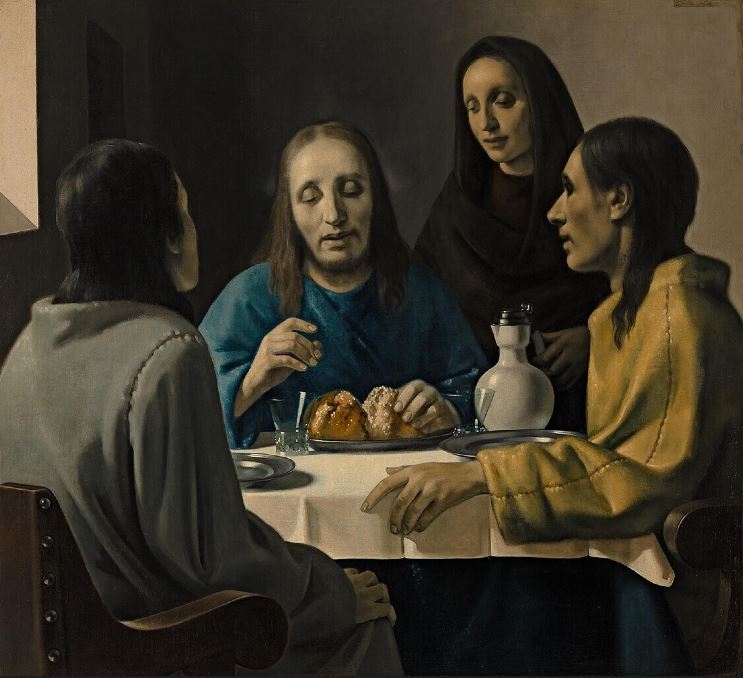 Han van Meegeren's fake Vermeer, Supper at Emmaus
Seen now by anybody who has viewed even a little of either's work, the forgeries look absurd. The figures look more readily from Picasso than sitters of the seventeenth-century Netherlands.
Van Meegeren did not really paint seventeenth-century Vermeers and De Hoochs; he painted the Vermeer and De Hooch that experts of the 1930s were so desperately wanting to see.
I am tempted to laugh at the defrauded, but it is more curious wonder what in our own picture of De Hooch will look equally obvious in another hundred years.
Further reading
- Counting Vermeer (RKD Studies), a deep technical overview of Vermeer's work.
- Vermeer (Rijksmuseum, 2023), the major modern Vermeer monograph and catalogue, discussing his complete oeuvre together and incorporating the latest art-historical research produced for the Rijksmuseum's landmark 2023 exhibition.
- Closer to Vermeer: New Research on the Painter and His Art (Rijksmuseum, 2025), a collection of the newest technical and art-historical research on Vermeer, using advanced imaging and archival research to examine his materials, working process, compositional changes, optics, patrons, and depicted objects.
- Blankert, nos. 8 & 11, dates the pictures to 1660–61 and 1662 respectively.↩
- Valentiner 1932, p. 315.↩
- Pinholes were found in several of De Hooch's paintings (listed below) and are very likely to be present in many more: Woman with a Child in a Pantry, Man Handing a Letter to a Woman in the Entrance Hall of a House, A Mother's Duty, Two Women Beside a Linen Chest with a Child (all Rijksmuseum, Amsterdam); A Woman Preparing Bread and Butter for a Boy (J. Paul Getty Museum, Los Angeles); The Courtyard of a House in Delft, possibly in A Woman and her Maid in a Courtyard and A Woman Drinking with Two Men (all The National Gallery, London); Couple with Parrot (Wallraf-Richartz-Museum, Cologne); A Woman with a Baby in her Lap, and a small Child (Aurora Art Fund, New York); A Boy Bringing Bread (The Wallace Collection, London); The Bedroom (National Gallery of Art, Washington); The Visit, Interior with a Young Couple (both Metropolitan Museum of Art, New York); A Man Smoking and a Woman Drinking in a Courtyard (Mauritshuis, The Hague).↩
- Gerbrand van den Eeckhout, Party on a Terrace, 1652, Worcester Art Museum.↩
- National Archives, Paris, no. O¹ 19182/136.↩
- J. B. P. Lebrun, Galerie des peintres flamands, hollandais et allemands, I, p. 52.↩
- W. Bode, Rembrandt und seine Zeitgenossen, Leipzig, 1906, p. 58.↩
- H. Jantzen, p. 7.↩
- See H. Posse's catalogue of the Kaiser-Friedrich-Museum, Berlin, I (1911), II (1913), and W. Rothes, 'Terborch und das holländische Gesellschaftsbild', 1921.↩
- C. H. Collins Baker, Masters of Painting: Pieter De Hooch, London, 1925, p. 2.↩
- The Connoisseur, 44 (1916), pp. 235–36; D. S. MacColl, 'The New De Hooch at the National Gallery', The Burlington Magazine, 29 (1916), pp. 25–26.↩
- A. Bredius, 'Een Prachtige Pieter de Hooch', Oud-Holland, 56 (1939), pp. 126–27.↩
- P. B. Coremans, Van Meegerens Vermeers and De Hooghs, Amsterdam, 1947; R. Breek & W. Froentjes, 'Application of Pyrolysis Gas Chromatography on some of Van Meegeren's Fake Vermeers and Pieter de Hoochs', Studies in Conservation, 20 (1975), pp. 183–89.↩