The Shin-hanga movement (lit “new prints”) was an art movement in early 20th-century Japan, during the Taishō and Shōwa periods, that revitalized the traditional ukiyo-e art rooted in the Edo and Meiji periods. It maintained the traditional ukiyo-e collaborative system where the artist, carver, printer, and publisher engaged in division of labour, as opposed to the parallel [[Sōsaku-hanga]] (creative prints) movement.
 In the garden of artist Itō Shinsui’s Tokyo home. Left to right, back row: Moriyama Tesutaro (assistant to publisher Watanabe); Kawase Hasui, collector Robert O. Muller, Inge Muller, Itō Yoshiko and Itō Shinsui. Left to right, front row: Kasamatsu Shirō and publisher Watanabe Shōzaburō, April 1940
Shin-hanga artists incorporated Western elements such as the impression of light and the expression of individual moods. It eschewed ukiyo-e traditions of emulating hand-drawn brushstrokes seeking instead to “create works replete with creativity and rich with artistic quality, by avoiding enslavement to hand-drawn painting or old models”.
Watanabe introduced new printing techniques, notably baren suji-zuri and goma-zuri layering on thicker, drier paper than earlier ukiyo-e. He saw shin-hanga as fine art (geijutsu), distinct from shinsaku-hanga, his term for cheaper souvenir prints like Takahashi Shōtei's. Shin-hanga themes stayed traditional; landscapes (fukeiga), famous places (meishō), beautiful women (bijinga), kabuki actors (yakusha-e), and birds-and-flowers (kachō-e).
Shin-hanga was popular with Western collectors, who saw it as nostalgic, romanticised fine art, and exhibitions in Boston (1924), Indianapolis (1926), and Toledo (1930, 1936) — the latter promoted by Hiroshi Yoshida — cemented its overseas reputation, with dealers like Robert O. Muller continuing to import prints through the 1930s and postwar. Domestically it fared worse: Meiji-era Westernisation had elevated yōga (Western oil painting) to official status via the Bunten, leaving shin-hanga dismissed as outdated ukiyo-e. As Western demand grew through the 1920s, prints simplified — fewer baren-suji and goma layers, brighter colours — and shin-hanga displaced shinsaku-hanga in the souvenir trade. Wartime militarisation and material rationing from the late 1930s, alongside collapsing overseas markets, brought steep decline. Postwar demand never fully recovered, though artists like Itō Shinsui and Shimura Tatsumi kept the collaborative tradition alive into the 1960s and 1970s, while later decades favoured reproductions and saw sōsaku-hanga eclipse it in prestige. A modest revival emerged in the early 21st century, driven by renewed interest in masters like Kawase Hasui and Yoshida and contemporary artists such as Paul Binnie — with Steve Jobs among its notable modern collectors.
Gallery
 Kawase Hasui, Ushibori (1930), Rijksmuseum.
 Kawase Hasui, Herfst in Oirase (1933), Rijksmuseum.
 Kawase Hasui, De Zensetsu tempel in Sanshu (1937), Rijksmuseum.
 Kawase Hasui, Yuki no Zōjō-ji (Snow at Zōjō Temple).
 Kawase Hasui, Miyajima in de mist (1947), Rijksmuseum.
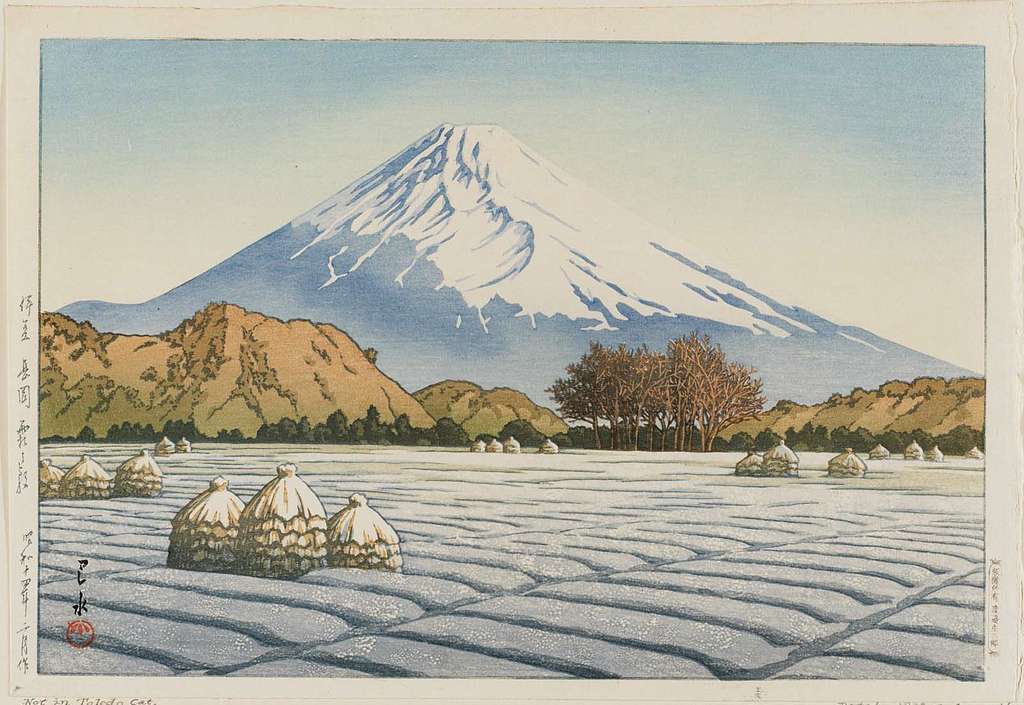 Kawase Hasui, Frosty Morning in Nagaoka, Izu (1939).
 Hiroshi Yoshida, Tomonoura Harbour (1930), Rijksmuseum.
Hiroshi Yoshida, Sacrificial Gate at Kumano Shrine (1925), Rijksmuseum.
 Kawase Hasui, Snow at Zojo-ji Temple (1925), Rijksmuseum.
 Kawase Hasui, Winter at Arashiyama (1920), Rijksmuseum.
 Natori Shunsen, The Actor Nakamura Ganjiro I as Kamiya Jihei (1927), Rijksmuseum.
Sources
- Wikipedia — Shin-hanga
- Artelino — Shin Hanga: History, Artists, Market and Collecting Guide
- Artelino — Shin Hanga and the Toledo Museum Exhibitions
- Museum für Ostasiatische Kunst Köln — Shin hanga
- Worcester Art Museum — Reflections of a Changing Japan: The Evolution of Shin Hanga
- Art & History Museum — Shin hanga